

Spring festival gala highlights China's tech ambitions via robotics showcase
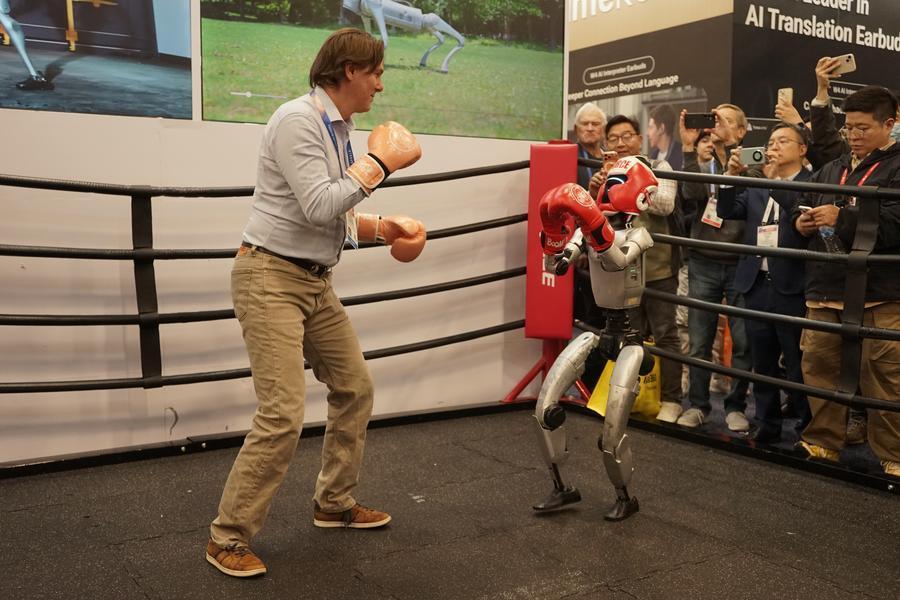
A robot from Chinese company Unitree is 景德镇政务新闻网官网displayed during the 2026 Consumer Electronics Show (CES) in Las Vegas, the United States, Jan. 8, 2026. (Photo by Zeng Hui/Xinhua)
BEIJING, Feb. 17 (Xinhua) -- The Year of the Horse's Spring Festival Gala, the world's most-watched television event, has delivered a powerful statement: China's technological spotlight has decisively shifted to robotics.
The 2026 gala's Monday night live broadcast augmented its traditional repertoire of song, dance and comedy skits with a high-stakes national showcase for cutting-edge humanoid robots, a vivid symbol of the country's rapid momentum toward a tech-driven future.
Leading the charge was Unitree Robotics, located in Hangzhou in east China, a returning performer that commanded attention last night. Moving beyond the somewhat stiff dance routines of 2025, its new robots took center stage in a martial arts spectacle, wielding swords and nunchucks alongside human masters from a renowned kung-fu school.
These robots executed complex maneuvers like drunken boxing, backward obstacle avoidance and backflips, underscoring a leap from demonstrating basic mobility to mastering intricate, culturally rich physical artistry.
The 2026 gala stunts, supported by AI algorithms and 3D LiDAR, included multiple world firsts: a continuous parkour-style table vaulting sequence, catapulted aerial flips reaching a maximum height exceeding 3 meters, single-leg consecutive aerial flips followed by a two-step wall-run into a backflip, airflare rotation at 7.5 revolutions, and clustered rapid repositioning achieving arbitrary movement speeds of up to 4 meters per second, according to Unitree Robotics.
"Unitree should get a robot Olympics going. It would be entertaining, and draw a lot of good attention to how capable humanoid robots are getting," Owen Lewis, a science enthusiast, commented on social media platform X in response to the show.
Another Chinese robotics startup MagicLab, seizing the coveted opening act, set the tone with its human-like machines performing a groundbreaking "Thomas 360 degree." Later, six units synchronized seamlessly with pop stars for a musical number.
While others showcased physical prowess, Beijing-based Galbot demonstrated its aptitude for performing everyday tasks, from delicately cracking walnuts, picking up glass shards and retrieving items from shelves to folding clothes and skewering sausages for grilling.
The Galbot robot handled each task with dexterous, natural human-like movements. This capacity for autonomous decision-making and hand-eye coordination signaled that Chinese-designed robotics is moving beyond mere showmanship, instead pointing and shifting toward vast practical applications.
The most poignant moment of the gala was delivered by Noetix Robotics. Its robots starred in a comedy skit, a throwback to one 30 years ago, when an actress played a whimsical, clumsy robot. This time, she performed alongside authentic humanoids, including a stunningly accurate bionic replica of herself, created in just 30 days.
The show's classic comedy-of-errors narrative probed a deeper question amid the AI technology wave: human-robot relations. It ultimately affirmed the irreplaceable value of human warmth and connection, suggesting that advanced robotics, rather than replacing humanity, should enhance and reflect our own qualities.
Noetix's robot, notably, finished second in last year's robot half-marathon in China's capital, following Tien Kung from Beijing.
This robotics invasion of the gala marks a pivotal cultural and commercial moment. For decades, the event's advertising chronicled China's economic shifts, from bicycles and liquor to home appliances and internet services.
Now, robots and AI have made inroads into this prime symbolic space, representing the new engine of "new quality productive forces." The performances translated technical jargon like "embodied AI" into a visceral, national experience.
More Chinese robotics firms also took to regional gala stages this year, including the likes of AgiBot, UniX AI and EngineAI, making technology an inescapable part of Chinese New Year celebrations nationwide.
Last week, AgiBot also staged a global live gala, showcasing a diverse lineup ranging from synchronized dances and comedic skits to magic acts and traditional martial arts.
A recent industry report revealed that Chinese robotics firms had emerged as the largest producers of humanoid robots worldwide in 2025. AgiBot achieved an annual shipment volume of over 5,100 units, securing a 39-percent share of the global humanoid robot market, followed by two more Chinese tech firms, namely Unitree and UBTECH.
The year 2026 marks a critical turning point for the robotics industry, with it moving from simply "handling many tasks with limited proficiency" to truly "accomplishing tasks with high performance and achieving practical application," said Luo Jianlan, chief scientist at AgiBot.
China has a clear national strategy in its quest to become a global robotics powerhouse, and the country has drawn attention and admiration from abroad thanks to its robust industrial ecosystems, fast iteration cycles and large-scale deployment capacity, said Dominic Gorecky, co-founder and director of Swiss Smart Factory.
- ·高卿尘《Give Me Five》MV正式上线|击掌为约,定格双向奔赴的温柔羁绊
- ·11月以来超300亿元贷款投向民营房企
- ·宁泽涛为什么被踢出游泳队 宁泽涛在游泳的表现以及现状
- ·去年可数字化交付服务进出口3727.1亿美元
- ·摸清家底!第五次全国经济普查结果出炉
- ·淮南春节期间又“嗨”又“燃”楚风汉韵
- ·中国科大科技商学院正式开建
- ·王玲:以真心换真情 做群众最信任的人
- ·六安市入选全国第三轮地方志书编修试点单位名单
- ·纪念袁世海先生诞辰110周年座谈会在京举行
- ·文博会今日开幕,广东文化产业谱写时代新篇
- ·中国客车在世界客车博览会受关注
- ·我国首次按“一区一价”核定跨省天然气管道运价
- ·淮北市举办“廉洁文化建设”美术书法作品展
- ·金监局:保持对民营企业稳定有效的增量信贷供给
- ·前三季度我国新改建农村公路11.8万公里